
Ten-minute hieroglyphs - Mini-lesson 9: Making a start on grammar (nouns)

Updated: 5 days ago

Learning objectives
By the end of this mini-lesson you will:
know that Egyptian nouns have grammatical gender and are either masculine or feminine; and
recognise the endings of singular and plural nouns and know how to transliterate them.
In the follow-up activities you’ll practise recognising noun endings and learn some common nouns referring to people. In the extension activity you'll meet some new biliteral and triliteral signs.
Nouns
Nouns are words that name people, creatures, places, things and abstract ideas. They include 'proper' nouns (e.g. 'Susan', 'Tutankhamun', 'London') as well as common nouns (e.g. 'student', 'king', 'city'). You've already met some Middle Egyptian nouns in the activities for Mini-lessons 4, 5 and 8.
Gender and number
Like many languages - although not English - Egyptian nouns have grammatical gender. There are two, masculine and feminine. All nouns must be one or the other. Sometimes you can predict the gender of a noun from its meaning (e.g. the word for 'god' is masculine and the word for 'goddess' is feminine), but generally the best way to distinguish grammatical gender is to look at the noun's ending (see below).
Nouns can be singular or plural (e.g. 'king' or 'kings'). They can also be dual - this is a special form used for pairs of things (e.g. 'two feet', 'two lands') which we'll leave for a future lesson.
Many nouns have endings that tell you their gender and number. Here are the endings for masculine and feminine singular and plural nouns.
Masculine | Feminine | |
Singular | No special ending | -t |
Plural | -w | -wt |
What does this look like in hieroglyphs?
Masculine nouns
Masculine singular nouns don't have a special ending. A few end in -t, so not every noun ending in -t is feminine. Here are some examples:

s meaning 'man'
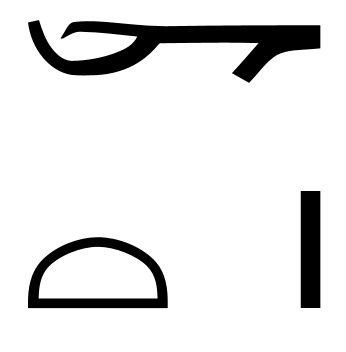
ḫt meaning 'wood'. This word ends in a -t but is masculine
Masculine plural nouns are usually written with the plural determinative (three strokes, which can be arranged in a variety of ways; three dots can also be used). In addition, the ending -w may be written with a phonetic sign, but because it represents a weak sound it is often omitted.

ẖrdw meaning 'children'. In this example, the -w (the masculine plural ending) is written with the quail chick.

nṯrw meaning 'gods'. In this example, the plural determinative shows that the noun is plural. You include the -w ending in the transliteration even though this is not written with a phonetic sign.
Feminine singular nouns have the ending -t, for example:
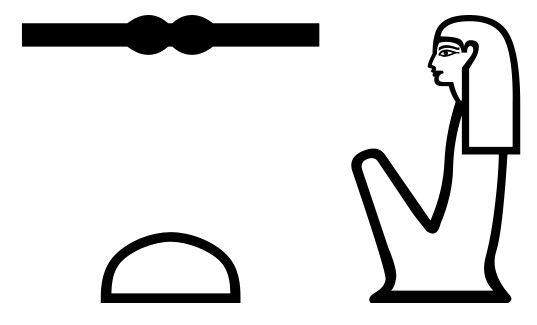
st meaning 'woman'
Feminine plural nouns have the ending -wt. You'll usually see just the -t written with a phonetic sign together with a plural determinative, for example:

ḫꜣswt meaning 'foreign lands'.
Sometimes a plural is represented by writing the word three times, for example:

prw meaning 'houses'. Note that there is no phonetic sign for the w but you still include it in the transliteration.
Why does this matter?
Number obviously matters, as when you translate a word you need to know whether it's referring to one or multiple things. There's a big difference between one soldier and an army's worth! From a translation point of view, for words referring to people, grammatical gender may help you get the correct meaning, and determinatives such as the man, woman, child, king, god and so on also help you decide what kind of person you're talking about. In the future you'll find that some other words, such as adjectives, may change their gender to match a noun, and you'll need to recognise this to translate accurately.
Tips for learners
Always include the w when you transliterate a plural noun (masculine or feminine), even if it isn't written with a phonetic sign.
Plurals of the same noun may be written differently in different texts (e.g. with plural dots instead of strokes or with or without a phonetic sign for -w). However, the transliterations are the same.
Follow-up
Complete the Mini-lesson 9 activities. You will:
sort nouns into masculine singular, feminine singular, masculine plural and feminine plural by looking at their endings and determinatives; and
use your knowledge of phonetic signs and determinatives to match each of the nouns (in its singular form) to its transliteration.
As an extra challenge, make your own list/ flashcards of the nouns in the activities and learn them as vocab.
Extension:
Learn some more multiliteral signs. You'll find a new set (Set 4) directly below the Mini-lesson 9 nouns activities.
Practise using a sign-list by looking up the new multiliteral signs and the ideograms that you met today.
In Mini-lesson 10, which will be posted soon, you'll learn some prepositions and read your first Middle Egyptian sentences.


